

FAMILYPSYCH
Legal and Forensic Assessment
Current projects.
What is it like to be in the justice system? Victimisation and recovery from victimisation in women victims and the professionals who support them
Susana Corral (University of Deusto) and Ana Eugenia Abásolo (Basque Institute of Legal Medicine)
The aim of this project is to explore the experiences of victims of gender-based violence and sexual assault in their interactions with the various professionals involved in the police, judicial and support processes, from the moment a complaint is filed and a legal case is initiated. In parallel, the project seeks to understand the experiences of professionals in the police, judicial and support sectors, as well as the impact of direct and sustained contact with victims of violent and traumatic processes on their well-being.
Demystifying love: preventing cyberviolence in university couples through feminist educational interventions
Berta Vall (PI, Ramon Llull University), Jaume Grané (Ramon Llull University), and Susana Corral (collaborator, University of Deusto)
Fascination with crime: true crime consumption, morbid curiosity, personality traits and hibristophilic orientations
Susana Corral (PI), Eva Carretero and Jaione Larrazabal
This study aims to explore the relationship between true crime content consumption, morbid curiosity, personality traits and hibristophilic orientations in a community sample. It seeks to gain a better understanding of the psychological characteristics associated with interest in real crime and how these relate to fascination with individuals who have committed criminal offences.
Beyond feminicide: psychological autopsy of suicide among victims and perpetrators of gender-based violence in Bizkaia
Susana Corral (University of Deusto) and Ana Eugenia Abásolo (Basque Institute of Legal Medicine)
The project will make a significant contribution to advancing knowledge on the relationship between suicide and gender-based violence, highlighting gender-based violence as a relevant factor in suicide and generating knowledge that is applicable to professionals in the healthcare, social, judicial and forensic fields.
First, the study will make it possible to identify and characterise precipitating factors of suicide in contexts of violence. Second, the study will generate empirical evidence that will allow for a more accurate reconstruction of the processes preceding suicide.
Resources.
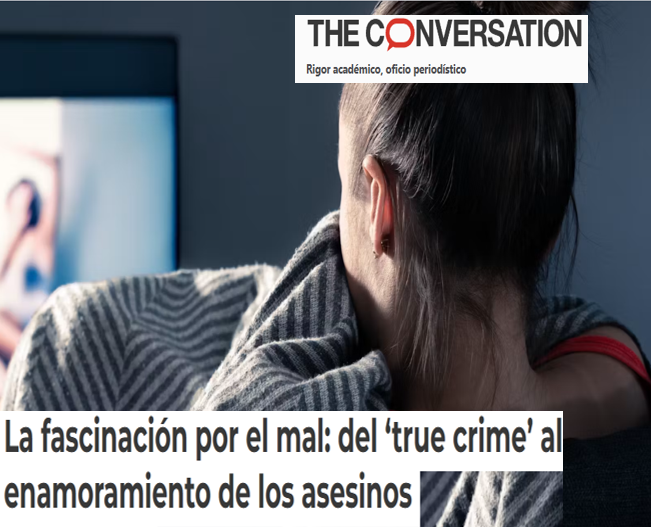
The fascination with evil: from true crime to attraction to murderers
Why do some people feel a disturbing attraction to criminals and true crime stories? This article explores the phenomenon of true crime and hibristophilia, the romantic or emotional fascination with offenders, from a psychological and social perspective. It examines how curiosity, the search for excitement and the understanding of human behaviour can lead us to become interested in darker aspects of life, without neglecting ethical reflection and the boundaries of morbid fascination.
Read the full article here: The fascination with evil
Participate
The fascination with crime and true crime consumption (coming soon)
Coming soon, participation in the study “The fascination with crime and true crime consumption” will be available. This research is aimed at the adult population, both men and women, and seeks to explore how the consumption of true crime content, including documentaries, series, podcasts, books and social media, is related to morbid curiosity, certain personality traits and fascination with individuals who have committed criminal offences. The study aims to better understand which psychological factors may be associated with interest in real crime, as well as to analyse the different ways in which people engage with this type of content: for entertainment, curiosity, psychological interest, learning or social reflection.
Participation will be voluntary and anonymous and will take place through an online questionnaire.
It is not necessary to be a regular consumer of true crime to take part; we are also interested in the views of people with different levels of interest in this type of content.